


All Categories
Purchase
Mobile
Contact Us
Top
Chinese
All Categories
Products
Suppliers
Purchase Request
Exhibitions/Events
News
Videos
Buyer
Supplier
Home News & Wiki Wiki List
Wiki Details
Share to

Polyethylene Glycol

聚乙二醇

English Alias:

Chinese Alias:

Category:

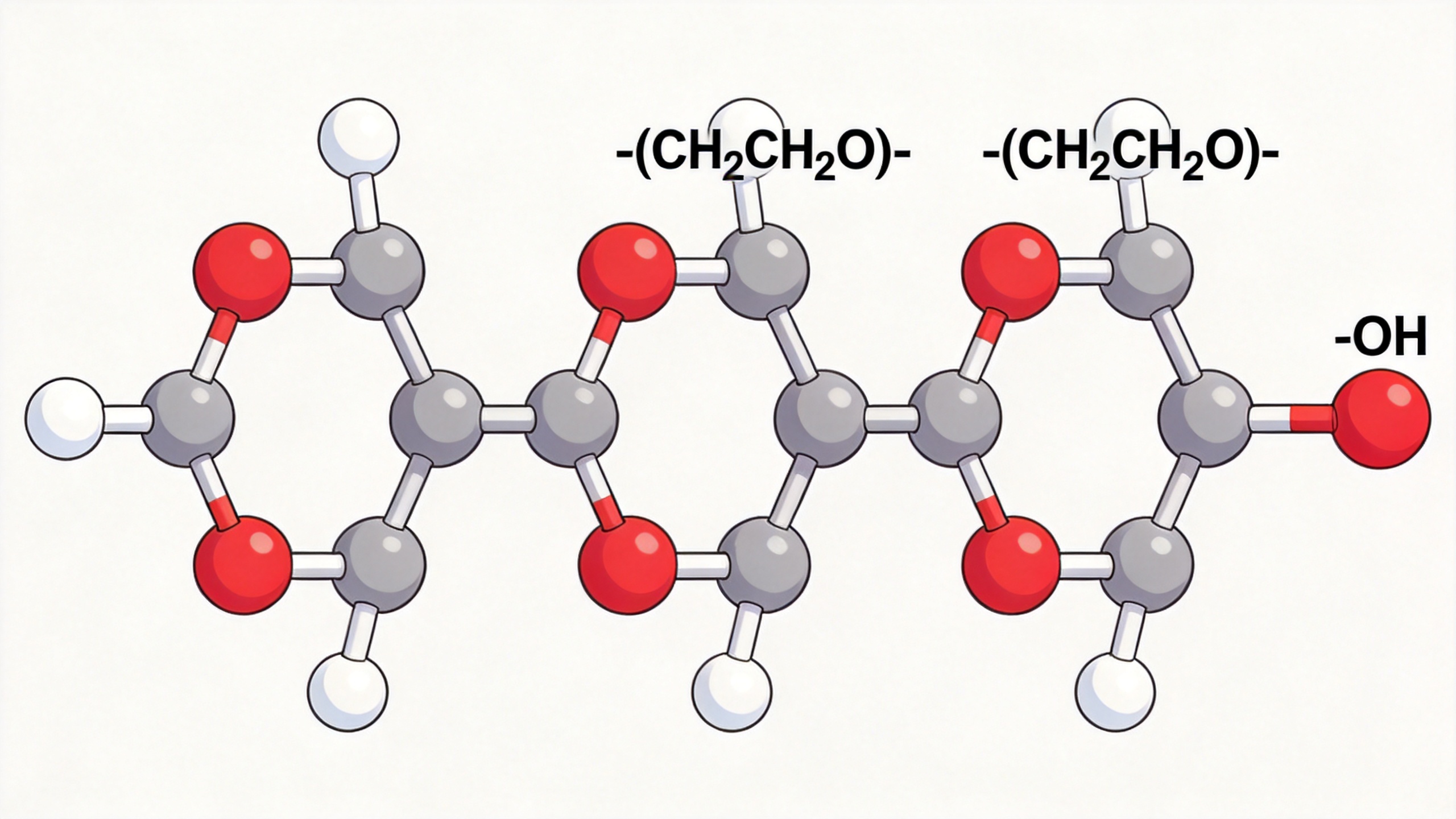
Polyethylene glycol (Polyethylene Glycol, referred to as PEG) is a linear polyether polymer compound formed by condensation of ethylene oxide and water. Its chemical formula is H(OCH₂ CH₂) OH, and its relative molecular mass ranges from 200 to 9500. As a food additive, polyethylene glycol is classified as a coating agent (INS No. 1521,CNS No. 14.012) and is mainly used in the field of coating confectionery and chocolate products. According to the "National Food Safety Standards for the Use of Fo
聚乙二醇
聚乙二醇
Definition
Industry Overview
Technical Standards
Application Areas
Security Control
Development Trends
Policies & Regulations
References
Definition
Polyethylene glycol (Polyethylene Glycol, abbreviated as PEG) is a kind of linear polyether compound prepared by ring-opening polymerization of ethylene oxide and water. Its complete chemical name is α-hydrogen-ω-hydroxyl (oxygen -1,2-ethanediyl) polymer, and its chemical structural formula is H-(OCH₂ CH)-OH, where N represents the degree of polymerization. The relative molecular mass of polyethylene glycol ranges from 200 to 9500 (calculated according to the international relative atomic mass in 2014), and different molecular weight grades determine the physical form and application characteristics of the product.

From the perspective of molecular structure, polyethylene glycol belongs to polyether polymer materials. Its main chain is formed by repeating ethylene glycol units (-OCH₂-) connected by ether bonds, and each end of the molecular chain has an active hydroxyl group (-OH). The structure of the two ends of the primary alcohol gives polyethylene glycol good chemical reactivity, so that it can be esterified with fatty acids, with isocyanate addition reaction, but also with multi-functional compounds cross-linking reaction. The molecular weight of polyethylene glycol can be accurately adjusted by controlling the degree of polymerization, and the size of the molecular weight directly affects its physical state: when the relative molecular mass is below 700, the product is colorless and transparent liquid state; When it is between 700 and 900, it is translucent liquid or waxy ointment; when it is above 1000, it is white waxy solid flakes or granular powder.

In the food additive classification system, polyethylene glycol is clearly classified as a coating agent. Coating agent refers to the substance that is applied to the appearance of food and plays the role of quality preservation, freshness preservation, polishing and preventing water evaporation. Compared with other coating agents, polyethylene glycol has unique advantages: its good water solubility makes it easy to clean and remove; its chemical stability ensures that its performance is not easy to change during storage and use; its non-toxic and non-irritating characteristics Ensure food safety. According to the provisions of the National Food Safety Standard Food Additives Use Standard (GB 2760-2024), the CNS number of polyethylene glycol is 14.012,INS number is 1521, and the functional category is coating agent.

From the perspective of historical evolution, the industrial production of polyethylene glycol began in the late 1930 s. In 1939, the United States Union Carbide Company (Union Carbide Corporation) took the lead in the industrial production of polyethylene glycol, and then the world's enterprises have invested in research and development and production. In the early days, polyethylene glycol was mainly used in industrial fields, such as textile auxiliaries, lubricants, etc. With the deepening of its safety research and the development of the food industry, polyethylene glycol was gradually approved for the field of food additives. China's standardized management of polyethylene glycol as a food additive began with the formulation and improvement of GB 2760 series of standards. The current effective quality specification standard is GB 1886.302-2021.

At the international level, polyethylene glycol has different nomenclature and classification systems in different regions. In the European Union, polyethylene glycol is numbered E1521, collectively referred to as "Polyethylene glycols, macrogols"; In the United States, the Food and Drug Administration (FDA) lists it as a "Generally Recognized as Safe"(GRAS) substance, which is allowed to be used in food contact materials and food processing aids. In the Codex Alimentarius's General Standard for Food Additives, polyethylene glycol has INS number 1521 and is approved for specific food categories.

From the analysis of essential attributes, the core characteristics of polyethylene glycol can be summarized as follows: First, the characteristics of water-soluble polymers-polyethylene glycol can be mutually soluble with water in any proportion to form a uniform and transparent solution, which is used as a coating agent. The basis; Second, chemical stability-under normal storage and use conditions, polyethylene glycol is not easy to decompose or deteriorate; third, biocompatibility-polyethylene glycol has no obvious toxic effect on the human body, it has been recognized as a safe food additive by many international authoritative organizations; fourth, molecular weight adjustability-by controlling the polymerization process, polyethylene glycol products of different molecular weight grades can be produced to meet different application requirements.

It is worth noting that polyethylene glycol and polyethylene oxide (Polyethylene oxide, referred to as PEO) and polyoxyethylene (Polyoxyethylene, referred to as POE) have similar chemical structure, the three are actually from the same monomer (ethylene oxide) polymerization of polymer family members, usually used interchangeably or refer to each other. In practical applications, when the average molecular weight is lower than 20,000g/mol, it is usually called polyethylene glycol (PEG), and when the molecular weight is higher than 20,000g/mol, it is called polyethylene oxide (PEO).
Industry Overview
As an important segment of the food additive industry, polyethylene glycol has shown steady development in China and the global market. From the perspective of the industrial chain, the upstream core raw material of the food-grade polyethylene glycol industry is ethylene oxide, and the downstream applications are mainly concentrated in the food industry fields such as candy manufacturing, chocolate production, and health food processing.

In terms of industrial chain structure, the production and manufacturing of food grade polyethylene glycol is in the middle of the industrial chain. The upstream link is dominated by the supply of ethylene oxide, which is the basic raw material for petrochemical industry, and its price fluctuation directly affects the production cost of polyethylene glycol. Midstream manufacturing involves polymerization, molecular weight regulation, purification, testing and packaging. Downstream applications can be divided into three major sectors: one is the coating of candy and chocolate products, which is the most important application field of polyethylene glycol as a coating agent; the second is the application of accessories in the production of health food; the third is the development of functional food additives.

From the perspective of market size, according to the industry data released by the China Chemical Industry Information Center, the total domestic food-grade polyethylene glycol production capacity at the end of 2024 is about 128000 tons/year, an increase of about 50.6 percent from 85000 tons/year in 2020, with an average annual compound growth rate of 10.7 percent. In 2025, the total output of domestic food grade polyethylene glycol has exceeded 85000 tons, and the market size has reached about 2.3 billion yuan. In the global market, the global polyethylene glycol market is about US $4.2 billion (about RMB 30 billion) in 2025, and is expected to reach US $7.14 billion in 2034, with a compound annual growth rate of about 6.1 per cent between 2025 and 2034. Food grade polyethylene glycol accounts for about 8% to 10% of the global polyethylene glycol market, which is a small but stable growth segment.

From the perspective of regional distribution, China is the world's largest producer and consumer of food-grade polyethylene glycol. Domestic consumption is mainly concentrated in East and South China, and the combined consumption of the two regions accounts for more than 60%. In East China, Jiangsu, Zhejiang and Shanghai are the core consumption areas, where a large number of candy and chocolate production enterprises are concentrated; in South China, Guangdong and Fujian are the focus of consumption, covering many food processing enterprises. The global market is dominated by the Asia-Pacific region, which accounts for 47% to 48% of the global polyethylene glycol market, North America for 26% to 27%, and Europe for 18% to 19%.

From the perspective of the main participants, the domestic food grade polyethylene glycol market presents a pattern of coexistence of domestic and foreign capital. Domestic head enterprises include Liaoning Oak Chemical, Jiangsu Yida Chemical, Zhejiang Real Madrid Technology, these enterprises through the integrated layout to effectively alleviate the pressure of raw material costs, in high purity PEG400, PEG600 and other mainstream models to achieve large-scale stable supply. In terms of international giants, Dow Chemical (Dow Chemical), BASF (BASF) and other companies have maintained strong competitiveness in the high-end food-grade polyethylene glycol market by virtue of their technological advantages and brand influence. It is worth noting that in recent years, domestic enterprises have made breakthroughs in key technical fields such as molecular weight distribution control and low aldehyde content treatment, and some products have passed FDA and EU certification to accelerate the process of import substitution.

Judging from the development stage, the food grade polyethylene glycol industry is in the transition stage from the mature development period to the transformation and upgrading period. The main driving factors for the development of the industry include: the continuous upgrading of the food industry demand for high-quality film agent growth, consumer health awareness to promote non-toxic, non-stimulating food additives market expansion, food safety supervision tightening raised the industry access threshold. In addition, the rapid expansion of functional foods, special medical foods and plant-based foods also provides new growth space for the food-grade polyethylene glycol industry.

From the perspective of development history, the development of China's food-grade polyethylene glycol industry can be divided into three stages: the first stage is the market introduction period (before 2000), polyethylene glycol is mainly used in industrial fields, and food-grade products are rarely used; The second stage is a period of rapid growth (2000-2015). With the improvement of the food safety standard system and the development of the food industry, the market demand for food-grade polyethylene glycol is expanding rapidly; the third stage is the high-quality development period (2016-present). Driven by the supply-side structural reform and the goal of "double carbon", the industry is transforming to high-quality development, with technological upgrading and green manufacturing becoming the main theme.

From the perspective of industry pain points, the main challenges facing the current food-grade polyethylene glycol industry include: the risk of raw material price fluctuations, ethylene oxide as a petrochemical product, its price is greatly affected by the international crude oil market; the pressure on environmental protection continues to increase, and the production process The waste water and waste gas treatment requirements are increasingly stringent; homogenization competition intensifies, low-end products are overcapacity, and high-end products rely on imports; and downstream customers have increased bargaining power, reducing industry profit margins.

From the perspective of driving factors, the main factors that promote the development of the food-grade polyethylene glycol industry include: the steady growth of the downstream food industry, especially the consumption upgrade demand of the candy and chocolate industries; the improvement of the food safety supervision system has created a fairer market competition environment for formal enterprises; technological progress has promoted the improvement of product quality and the expansion of application fields; and the national industrial policy has increased support for the food additive industry.
Technical Standards
The technical standard system of polyethylene glycol as a food additive covers three levels: international standards, national standards and industry standards. The standards at all levels are connected and complement each other to form a complete quality and safety assurance system.

At the international standard level, the FAO/WHO Joint Expert Committee on Food Additives (JECFA) conducted a systematic evaluation of polyethylene glycol at its 23rd meeting in 1979. Based on the fact that no adverse effect dose (NOAEL) was observed in the study of 2% dietary exposure level (equivalent to 1000 mg/kg body weight) in rats, the allowable daily intake (ADI) of polyethylene glycol was set at 0-10 mg/kg body weight. The assessment report is contained in JECFA Technical Report Series No. 648 (JECFA 23/17). JECFA has also formulated the specification standard of polyethylene glycol (Specs Code: R,1987), which stipulates the average molecular weight range, ignition residue, heavy metal and other index requirements.

In terms of Codex Alimentarius standards, polyethylene glycol is included in the Codex Alimentarius Food Additive Specification List (CXM 6-2021), numbered INS 1521. The Codex Alimentarius Committee recognized JECFA's safety assessment of polyethylene glycol and approved it as a coating agent for specific food categories. The European Food Safety Authority (EFSA) Scientific Committee Food Sub-Committee (SCF) evaluated polyethylene glycol (PEG 300-4000) for the manufacture of regenerated cellulose membranes in 1978, setting a tolerable daily intake (TDI) of 5 mg/kg body weight. In 2018, the EFSA Food Additives and Nutritional Sources Panel (ANS Panel) issued a refined exposure assessment report showing that the dietary exposure level of polyethylene glycol (E 1521) fell within the health guidance values set by SCF and JECFA.

At the level of national standards, China has developed a comprehensive national standard system for polyethylene glycol food safety. In terms of quality specifications and standards, the National Food Safety Standard Food Additive Polyethylene Glycol (GB 1886.302-2021) was jointly issued by the National Health Commission and the State Administration of Market Supervision and Administration, and was officially implemented on August 22, 2021, replacing the previous relevant standards. This standard is applicable to polyethylene glycol, a food additive made by the polycondensation of ethylene oxide and water, and specifies the basic parameters such as chemical name (α-hydrogen-ω-hydroxy (oxygen -1, 2-ethanediyl) polymer), structural formula, molecular formula and relative molecular mass (200-9500).

The technical requirements of GB 1886.302-2021 include sensory requirements and physical and chemical indicators. In terms of sensory requirements, according to the relative molecular mass, the product can be colorless and transparent (below 700), translucent (700-900) or white (above 1000); the state can be liquid, liquid or waxy ointment, waxy solid flakes or granular powder. In terms of physical and chemical indexes, the standard specifies in detail the variation range of average relative molecular mass (95%-105, 90%-110 or 87.5-112.5 depending on molecular weight), pH value (5% aqueous solution, 4.5-7.5), viscosity and acid value (based on acetic acid, ≤ 0.05%), ethylene oxide residue (≤ 0.02%), dioxane residue (≤ 0.001%), ethylene glycol and diethylene glycol total (≤ 0.25%), ignition residue (sulfate, ≤ 0.2%), lead (≤ 1.0 mg/kg) and total arsenic (≤ 1.0 mg/kg).

In terms of use standards, the "National Food Safety Standards for the Use of Food Additives" (GB 2760-2024) stipulates the requirements for the use of polyethylene glycol as a coating agent. According to the standard text and Appendix A, polyethylene glycol (CNS No. 14.012,INS No. 1521) is allowed to be used for coating candy and chocolate products (food classification No. 05.03), and the maximum usage amount is "appropriate according to production needs". This regulation reflects the recognition of the safety of polyethylene glycol-under the premise of meeting the quality specifications, the manufacturer can determine the amount of use according to the process needs.

In terms of industry standards and certification systems, the International Pharmaceutical Excipients Committee Good Manufacturing Practice (IPEC-GMP) standards put forward strict requirements for the production quality management of pharmaceutical grade and food grade polyethylene glycol, including plant facilities, production process control, quality management, etc. Some food-grade polyethylene glycol manufacturers have also obtained FSSC 22000 food safety management system certification, ISO 22000 food safety management system certification, Kosher (kosher) certification and Halal (halal) certification to meet the access requirements of domestic and foreign markets.

From the perspective of standard evolution, China's national standards for polyethylene glycol food safety have undergone a process of continuous improvement. The current effective GB 1886.302-2021 is more scientific and reasonable in the setting of technical indicators, the detection method is more accurate and reliable, and the degree of integration with international standards is significantly improved. The release and implementation of this standard provides a more complete technical and regulatory basis for the production, circulation and use of food-grade polyethylene glycol.

From the perspective of international standard comparison, Chinese standards are consistent with international standards such as JECFA and EFSA in terms of core safety parameters, including ADI value setting, molecular weight range regulation, heavy metal limit, etc. However, in terms of specific technical details, there are some differences in national standards: FDA lists polyethylene glycol with an average molecular weight of 200-9500 as an available additive for food contact materials (21 CFR 178.3750), and makes different regulations on ethylene glycol and diethylene glycol residues for products with different molecular weights; The European Union expanded the scope of E1521 to molecular weight 200-10000 and made supplementary provisions for products with specific molecular weight (such as PEG 1000).

Judging from the development trend of future standards, with the continuous deepening of food safety scientific research and the continuous progress of testing technology, the relevant standards of polyethylene glycol will further develop in the direction of refinement and strictness. The National Center for Food Safety Risk Assessment (CFSA) launched a special study on the health effects of long-term intake of food-grade polymer additives in 2025, focusing on the potential risks of polyethylene glycol in intestinal microecological disturbance and nanocarrier migration. The results of this study may have an important impact on the revision and improvement of future standards.
Application Areas
Recommended Suppliers
Jinan Conquer Universe Chemical Technology Co., Ltd.
China Mainland·Shandong
普通会员
1
Year
Exhibitor
Main Products:
Food grade ethanol, alcohol, anhydrous ethanol, didehydroethanol, propylene glycol, sodium hypochlorite, potassium carbonate, glycerol triacetate, silica, sodium lactate, sorbitol, maltodextrin, glucose, sodium tripolyphosphate, sodium hexametaphosphate,
Contact Person:于**
Email:****945368@lqq.com
Send Card
Enter Store
JIANGSU XIXIN VITAMIN CO.,LTD.
China Mainland·Jiangsu
普通会员
1
Year
Exhibitor
Main Products:
Food Raw Materials and Ingredients
Contact Person:仲**
Email:****lla@xixingroup.com
Send Card
Enter Store
INFOARK HEALTHCARE CO., LIMITED
China Mainland·Beijing
普通会员
1
Year
Exhibitor
Main Products:
Food Raw Materials and Ingredients
Contact Person:高**
Email:****yuejia@infoark.com.cn
Send Card
Enter Store
More Reading
View More
Procurement Opportunity
View More
Feeder System

Grö***Bladet AB Company Profile

2026-05-12

Validity Remaining 36 Day
Submit Quote
Domino Inkjet Printer

Grö***Bladet AB Company Profile

2026-05-12

Validity Remaining 36 Day
Submit Quote
Vertical Form Fill Seal (VFFS)

Grö***Bladet AB Company Profile

2026-05-12

Validity Remaining 36 Day
Submit Quote
Working Platform

Grö***Bladet AB Company Profile

2026-05-12

Validity Remaining 36 Day
Submit Quote
Multihead Weigher

Grö***Bladet AB Company Profile

2026-05-12

Validity Remaining 36 Day
Submit Quote
Z-Type Bucket Elevator

Grö***Bladet AB Company Profile

2026-05-12

Validity Remaining 36 Day
Submit Quote
10 Heads Weigher packing machine

ibr***m@gronabladet.se

2026-05-12

Validity Remaining 36 Day
Submit Quote
Spout pouch

mim***lab manufacturing company limited

2026-05-12

Validity Remaining 36 Day
Submit Quote
new vertical sealing jaws

Nat*** One dairy PTY LTD

2026-05-12

Validity Remaining 36 Day
Submit Quote
inquiry of milk powder

0

2026-01-21

Validity Expired
Submit Quote
Feeder System

Gröna Bladet AB Company Profile

2026-05-12

Validity Remaining 36 Day
Submit Quote
Domino Inkjet Printer

Gröna Bladet AB Company Profile

2026-05-12

Validity Remaining 36 Day
Submit Quote
Vertical Form Fill Seal (VFFS)

Gröna Bladet AB Company Profile

2026-05-12

Validity Remaining 36 Day
Submit Quote
Working Platform

Gröna Bladet AB Company Profile

2026-05-12

Validity Remaining 36 Day
Submit Quote
Multihead Weigher

Gröna Bladet AB Company Profile

2026-05-12

Validity Remaining 36 Day
Submit Quote
Z-Type Bucket Elevator

Gröna Bladet AB Company Profile

2026-05-12

Validity Remaining 36 Day
Submit Quote
10 Heads Weigher packing machine

ibrahim@gronabladet.se

2026-05-12

Validity Remaining 36 Day
Submit Quote
Spout pouch

mimcoslab manufacturing company limited

2026-05-12

Validity Remaining 36 Day
Submit Quote
new vertical sealing jaws

Nature One dairy PTY LTD

2026-05-12

Validity Remaining 36 Day
Submit Quote
inquiry of milk powder

0

2026-01-21

Validity Expired
Submit Quote
Wiki Contribution

Become a creator on our food processing and packaging platform~

Submit Article