


Definition
Core Concepts
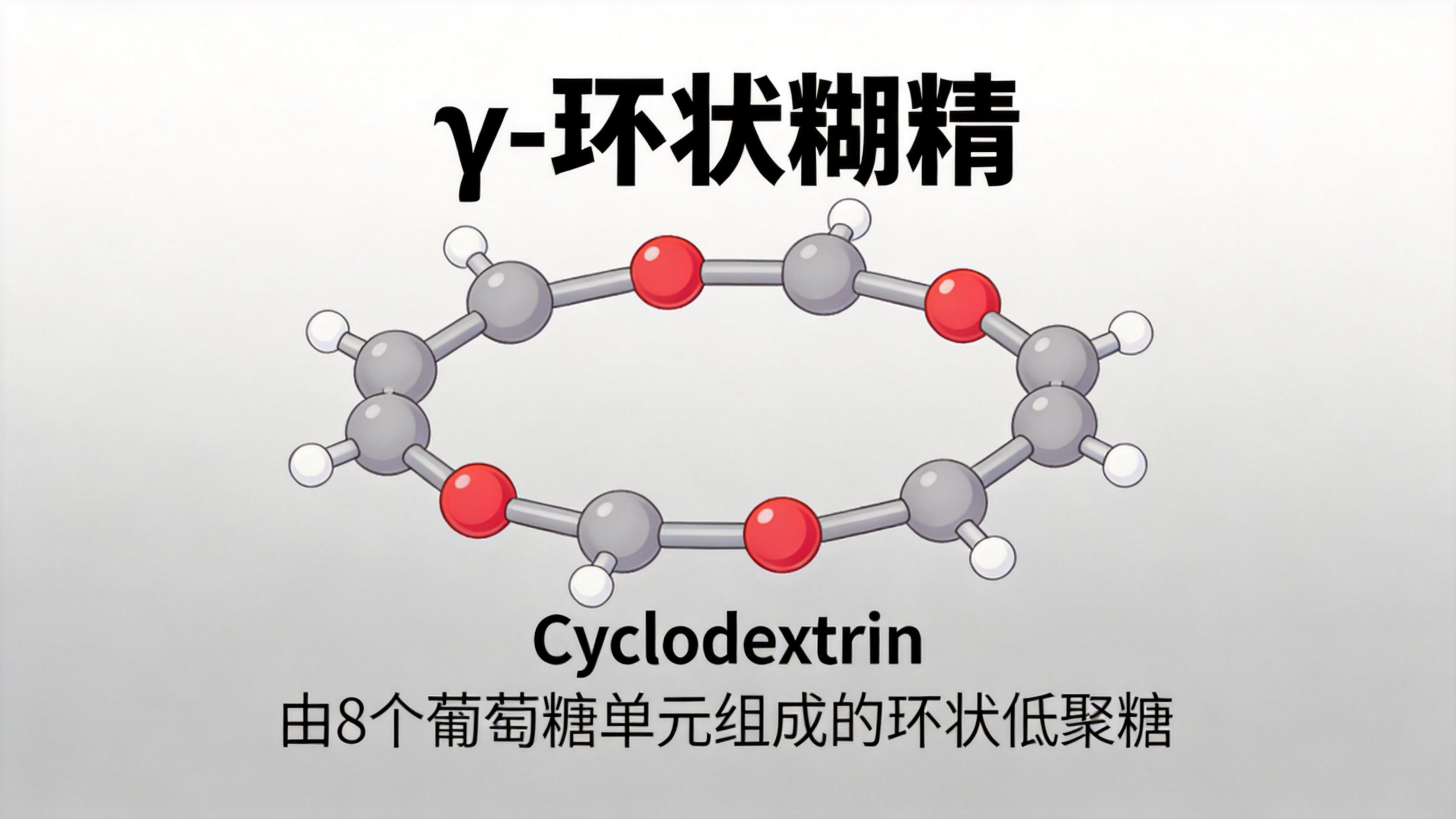
γ-Cyclodextrin refers to a cyclic oligosaccharide formed by eight D-glucopyranose residues linked end-to-end by α-1,4 glycosidic bonds, commonly referred to as gamma-cyclodextrin or γ-cyclodextrin in English. It is one of the important members of the cyclodextrin family, and it is also a functional ingredient used in the food additive industry for stabilization, thickening, emulsification assistance, embedding protection and improving the dispersion of substances. Its typical molecular formula is C48H80O40, the molecular weight is about 1297.1, the basic structure is truncated cone or barrel, the outside of the molecule is rich in hydroxyl and shows hydrophilicity, and the internal cavity is relatively hydrophobic. This spatial structure enables it to form non-covalent inclusion complexes with guest molecules of appropriate size and hydrophobicity, thereby changing the water dispersibility, volatility, oxidative stability, and processing tolerance of the guest molecules.
Terminology Teardown
"γ" indicates that the cyclodextrin is composed of eight glucose units to distinguish it from α-cyclodextrin composed of six glucose units and β-cyclodextrin composed of seven glucose units. "Cyclodextrin" emphasizes that it is derived from the conversion product of amylase method and belongs to a kind of cyclic maltooligosaccharide. In the context of food industry, γ-cyclodextrin is not equivalent to ordinary starch, dextrin or maltodextrin; ordinary dextrins are mostly linear or branched hydrolysates and lack stable annular hydrophobic cavities, while the functional value of γ-cyclodextrin mainly comes from the regular cyclic structure and inclusion capacity. In China's national food safety standard system, the substance usually takes "food additive γ-cyclodextrin" as the product standard object, and is managed according to the function and scope of application in the food additive use standard.
essential attribute
From the chemical nature, γ-cyclodextrin belongs to carbohydrate cyclic oligosaccharides, rather than synthetic polymer thickeners. Its production usually takes starch as raw material, and the cyclic structure is formed by cyclodextrin glucosyltransferase catalysis, and then the food additive grade products are obtained through separation, purification, drying and other steps. Compared with traditional thickeners, its viscosity contribution is usually not the main value, but more reflected in micro-entrapment, stability and solubility adjustment; compared with emulsifiers, it does not necessarily significantly reduce the interfacial tension, but through the inclusion of fat-soluble molecules, adjust the crystallization or dispersion state to improve the stability of the system. Therefore, when it is classified as "stabilizer, thickener", it should be understood as the application function in the functional classification of food additives, rather than simply as a colloidal thickening material.
synonymous and synonymous expressions
Common Chinese expressions of γ-cyclodextrin include γ-cyclodextrin, gamma cyclodextrin, γ-type of cyclodextrin, etc.; English equivalents include gamma-cyclodextrin, γ-cyclodextrin, cyclooctaamylose, etc. The near sense concept includes α-cyclodextrin, β-cyclodextrin, hydroxypropyl β-cyclodextrin, methylated cyclodextrin, and the like. It should be noted that there may be differences in substituents, solubility, toxicological evaluation and regulatory identity between substituted cyclodextrin and natural γ-cyclodextrin, and they cannot be substituted for each other in food additive compliance documents. Food formulations, labels and inspection reports should use names consistent with applicable standards to avoid the use of "cyclodextrin" generic names instead of specific varieties, resulting in unclear compliance boundaries.
Applicable boundary
The scope of application of gamma-cyclodextrin is mainly limited to the use of food additives permitted by laws and regulations and the corresponding food categories. In food systems, it can act as a stabilizer, thickener or carrier, and is often used to improve the processing stability of flavor ingredients, fat-soluble functional ingredients, pigments or sensitive ingredients. The applicable boundary is determined by three levels: first, the product itself should meet the requirements of the national food safety standards for sensory, identification, content, drying reduction, residue on ignition, lead, microorganisms and other indicators; third, product labels and formulations claim that process stabilization should not be exaggerated as disease prevention, treatment or pharmacological effects. In the current public authoritative information, there is no separate unified official statistics on the market consumption of gamma-cyclodextrin in various types of food, so it is not appropriate for industry analysis to infer its consumption scale.
historical evolution
The research of cyclodextrin can be traced back to the study of starch degradation products in the late 19th and early 20th centuries. Early scientists found that certain microbial enzymes could convert starch into cyclic oligosaccharides with crystallinity and unique inclusion ability. With the development of enzyme engineering, chromatographic separation and crystallization purification technology, three kinds of natural cyclodextrin, α, β and γ, are gradually clearly distinguished. Because of its large cavity, good water solubility and suitable for the inclusion of large guest molecules, γ-cyclodextrin has attracted attention in the research of food, nutrition, flavors and pharmaceutical excipients. The application evolution in the food industry has generally experienced the process from "special embedding materials" to "functional stable carriers", and its standardized management has gradually been incorporated into the national food safety standards and the international food additive evaluation framework from individual product quality control.
different perspectives
From the perspective of food chemistry, γ-cyclodextrin is a typical material for studying the inclusion of host and object, molecular recognition and stability of food components. From the perspective of food engineering, it is a processing tool to improve pulverization, dispersion, fragrance preservation and antioxidant stability. From the perspective of regulations, it is a substance that must accept the restrictions of food additive use standards, product specifications and safety evaluation. From the perspective of consumer protection, it is not sufficient evidence of nutritional efficacy in itself, and products containing gamma-cyclodextrin still need to be labeled and claimed according to general food, special food or other appropriate categories.
Related Concepts
Compared with α-cyclodextrin, γ-cyclodextrin has a larger cavity and can accommodate objects with larger molecular volume; compared with β-cyclodextrin, γ-cyclodextrin usually has higher water solubility, but production cost and separation and purification difficulty may also be higher. Compared with maltodextrin, the core function of γ-cyclodextrin is not simply to increase the solid content or improve the taste, but to change the physical and chemical behavior of the guest molecule through the inclusion structure. Compared with the microcapsule wall material, it can be used as a molecular-level embedding material to participate in the microcapsule system, but it does not completely replace the protein, colloid, polysaccharide or lipid wall material. The above differences determine that γ-cyclodextrin should be selected in the formulation design according to the target composition, processing conditions, regulatory restrictions and cost constraints.
Industry Overview
industrial chain structure
The industrial chain of γ-cyclodextrin is based on the deep processing of starch and the manufacture of food additives. Upstream mainly includes corn, potato, cassava and other starch raw materials and enzyme preparations, filter materials, food-grade solvents or water treatment systems and other supporting elements. The midstream is the production and refining of cyclodextrin, which usually includes starch liquefaction, enzymatic cyclization, conversion liquid purification, target component separation, decolorization, concentration, crystallization or spray drying, powder treatment and quality inspection. Downstream is mainly for food ingredients, flavors and fragrances, nutritional products, beverage powders, baking compound ingredients, functional formula carriers, and some food-related research and development scenarios. Due to the high requirements for purity, odor, microorganisms, heavy metals and inter-batch stability, midstream enterprises usually need to have a strong quality management system, food safety control system and testing capabilities.
Market size
In terms of market size, publicly available authoritative information usually classifies γ-cyclodextrins as cyclodextrins, modified starches, food additives or functional ingredients, and does not separately publish the global or Chinese γ-cyclodextrins market size, growth rate and share in official statistics. Some business research reports give market estimates for cyclodextrins or food additives, but their methods, samples, and calibers are often not fully disclosed, so they should not be cited as definitive official data in encyclopedia entries. A more secure statement is that γ-cyclodextrin is a small variety of highly functional food additives and ingredients, and its demand is influenced by factors such as food industry refinement, flavor stabilization, water dispersion of fat-soluble ingredients, improvement of low-sugar and low-fat formulations, and development of special dietary products. Compared with bulk thickeners, the amount used is usually lower, but the unit functional value is higher.
Key Participants
Industry participants can be divided into three categories. The first category is raw material manufacturing entities with starch deep processing, enzymatic conversion and food additive production capabilities. The second category is the main body of compound food additives and food ingredients service, which is responsible for combining γ-cyclodextrin with flavors, pigments, nutrients or other carriers into specific application schemes. The third category is food production enterprises and research and development institutions, which are responsible for verifying stability, flavor release, storage performance and label compliance in specific products. In accordance with user requirements, this article does not list specific business or brand names. Overall, the competitiveness of head producers mainly comes from enzyme conversion efficiency, separation and purification process, food safety system, batch consistency, application of technical services and international regulatory adaptation capabilities, rather than relying solely on capacity scale.
development stage
The γ-cyclodextrin industry is in the stage of deepening the transition from technology introduction to application. Compared with traditional starch sugar, modified starch and conventional thickeners, the application threshold of γ-cyclodextrin is higher, and it is necessary to combine the molecular inclusion mechanism with food formulation engineering. Early applications focused on embedding aroma substances, improving the dispersion of fat-soluble substances and reducing bad odors, and as the food industry's requirements for nutritional fortification, clean labels, low-calorie formulations and processing stability increased, gamma-cyclodextrins gradually entered more sophisticated formulation design scenarios. However, its price, regulatory boundaries, detection methods and consumer awareness still limit mass adoption.
regional pattern
In the international market, the areas with earlier application of cyclodextrin usually have more mature research and development system of food ingredients, research basis of pharmaceutical excipients and experience in regulatory evaluation. The Chinese market is characterized by the large scale of the food industry, the sufficient base of starch raw materials, and the continuous improvement of the food additive regulatory system, but the open market data of gamma-cyclodextrin as a single product is limited. Regional competition is not fully reflected in low-price competition, but also in standard compliance, stable supply, application development and export compliance capabilities. For export-oriented foods or ingredients, producers also need to consider target market requirements for food additives, processing aids, nutritional supplements, labeling and residue limits.
development process
The development process of the industry can be summarized into three stages: the first stage is the laboratory research stage, which focuses on clarifying the structure, inclusion mechanism and preparation method of cyclic dextrin; The second stage is the industrialization stage, enzyme engineering and separation and purification technology reduce the difficulty of production and make food-grade products possible. The third stage is the application of refinement stage, food developers began to evaluate inclusion constants, release profiles, particle size distributions, and sensory effects around specific guest molecules, processing, and shelf-life objectives. In China, after the gradual improvement of the national food safety standard system, the product specifications and use requirements of gamma-cyclodextrin have a clearer compliance basis.
Industry pain points
Industry pain points mainly include four aspects. First, the production cost is higher, and the separation and purification requirements of γ-cyclodextrin in the cyclic dextrin family are higher, resulting in its price is usually higher than that of conventional carriers and some thickeners. Second, the application evaluation is complex, and the inclusion effect is affected by the size of the guest molecule, polarity, pH, temperature, water activity and competitive components, and cannot be judged simply by the amount of addition. Third, the cost of regulatory communication is high, and there are differences in the names, functions, scope of use and labeling of food additives in different countries and regions. Fourth, consumers have limited understanding of the concept of "cyclodextrin". If the enterprise publicizes it improperly, it may cause misunderstanding of the function and safety of food additives.
Driving Factors
Factors driving the development of the industry include the food industry's demand for stability and shelf life, the demand for functional ingredient formulation, the growth of powdered and dissolved products, the improvement of low-sugar and low-fat formulations, the improvement of flavor and fragrance retention technology, and the improvement of the food safety standard system. At the same time, green manufacturing and enzymatic process optimization may also reduce unit energy consumption and production costs. The long-term development of the industry depends on two conditions: first, the ability to demonstrate the irreplaceable value of gamma-cyclodextrin in a particular scenario with verifiable application data; and second, the ability to achieve clearer label expression and consumer communication without expanding regulatory risks.
Technical Standards
International Standards
From the perspective of international standards, there is no product standard developed by ISO, IEC or ITU for food additive grade γ-cyclodextrin in the current public authoritative information. The field of food additives usually relies more on the Joint Expert Committee on Food Additives, the Codex Alimentarius system, national food regulations and pharmacopoeias or food chemical specification systems. The Joint Food Additives Expert Committee has evaluated the safety of gamma-cyclodextrin and paid attention to its identification, purity, residue and safety indicators in the food additive specification system. At the core of the international level is not a single number standard, but a regulatory consensus around toxicological evaluation, daily intake, product specifications, pollutant control and use necessity. For subjects engaged in cross-border trade, it is not possible to presume that all markets can be used only on the basis of the permission of a certain region, but to check the food category, functional category and labeling requirements of the target market one by one.
National Standards
China's national food safety standard system is the main basis for the use of gamma-cyclodextrin in China's food industry. GB 2760-2024 "National Food Safety Standards for the Use of Food Additives" stipulates the principles for the use of food additives, the permitted varieties, the scope of use and the maximum amount of use or the conditions for the appropriate amount of use according to production needs. Gamma-cyclodextrin is managed as stabilizer, thickener and other functions in the relevant food additive catalogue, and the specific scope of application shall be subject to GB 2760 and its subsequent repair orders. GB 1886.353-2021 "National Food Safety Standard Food Additive γ-Cyclodextrin" stipulates the technical requirements, test methods, inspection rules and other contents of the product, which is an important basis for judging whether the food additive grade product is qualified. Different from general chemical standards, national food safety standards emphasize indicators directly related to human health and production hygiene control.
Industry standards and group standards
In addition to national standards, industry organizations, research institutions, and application parties may form group standards, technical guidelines, or corporate internal control specifications around cyclodextrin testing, compounding applications, clathrate preparation, or food ingredient quality control. There are a limited number of widely cited industry standards for γ-cyclodextrins in the current public authority; therefore, encyclopedic expressions should avoid claiming the existence of a uniform system of industry standards. In actual production, companies usually establish stricter internal control indicators based on national standards, such as particle size, whiteness, odor, inclusion capacity, microbial limits, inter-batch differences, and inclusion rates for specific object molecules. If a group standard is used in a procurement or quality agreement, it should be clear that its legal rank is lower than the national food safety standard and must not reduce the mandatory food safety requirements.
certification system
Gamma-cyclodextrin production and application involves multi-layer certification. The main body of food additive production in China usually needs to meet the requirements of food production license, food safety management, production process hygiene control and inspection capacity. In terms of quality systems, common requirements include food safety management systems, hazard analysis and critical control point concepts, supplier audits and traceability systems. For export or special customers, additional requirements such as religious diet certification, non-GMO declaration, allergen control, sustainable sourcing declaration may also be involved. It should be emphasized that certification cannot replace regulatory licensing; even if a product has a complete system certification, it must still comply with the scope of use specified in GB 2760 and the product specifications specified in GB 1886.353.
Standards Evolution
The evolution of γ-cyclodextrin related standards is closely related to the improvement of food additive regulatory system. In the early days, the management of food additives relied more on variety catalogues and hygiene standards. With the integration of the national food safety standard system, product specifications, use standards, general hygiene standards for production and labeling standards gradually formed a convergence. The establishment of GB 1886 series standards makes the definition, technical requirements and inspection methods of single food additive products more clear. The update of GB 2760 reflects the dynamic adjustment of food category system, food additive function and safety evaluation results. The core direction of standard evolution is to improve transparency, enhance risk management capabilities, reduce duplication or conflict standards, and maintain coordination with internationally accepted evaluation methods.
Standard comparison
The differences in the management of γ-cyclodextrin in different countries and regions are mainly reflected in the regulatory identity, allowed food categories, maximum usage, label identification and technical specifications. Some areas manage it as a food additive or processing aid, some areas may be accepted for use in specific food categories or for specific uses, and some areas need to be evaluated in terms of new food ingredients, food contact-related substances or special ingredient pathways. The Chinese standard emphasizes the correspondence between the catalogue of food additives and the table of food categories, and the user must follow the scope of the standard. In international trade, formula development should not only check the Chinese standard name, but also check the English name, CAS information, INS or E number, specification standard and target country regulatory database.
Standard Implementation
The key to the implementation of standards lies in the parallel of inspection and formula compliance. In terms of product inspection, it should be confirmed that γ-cyclodextrin meets the requirements of identification, content, drying reduction, ignition residue, lead, microorganism and other indicators, and the batch inspection report should be retained. In terms of formula compliance, it should be confirmed that the final food category, use function, addition amount, compound form and label identification are in line with the current standards. Common problems in practice include misuse of industrial-grade or reagent-grade raw materials for food, understanding the allowable scope of use as common to all foods, ignoring the limit requirements for each monomer in compound food additives, and expressing stabilization as nutritional or health effects in labeling or publicity.
Future standards
The development of future standards may focus on four directions: first, to further improve the detection methods of γ-cyclodextrin and its inclusion compounds, and to improve the ability to identify the true addition amount and residue state; The second is to refine the labeling rules for compounded food additives and carriers to enhance consumers' right to know. The third is to promote the coordination of green manufacturing, enzymatic production and pollutant control indicators. The fourth is to strengthen the docking with Codex Alimentarius and major trading partner standards. If new clathrates, modified cyclodextrins, or nano-sized applications enter the food field, regulators may require more adequate safety evaluations, exposure assessments, and use restrictions. At present, there is no unified road map for future special standards in the public authority information, so the relevant judgment should be cautious.
Application Areas