


Definition
Core Concepts
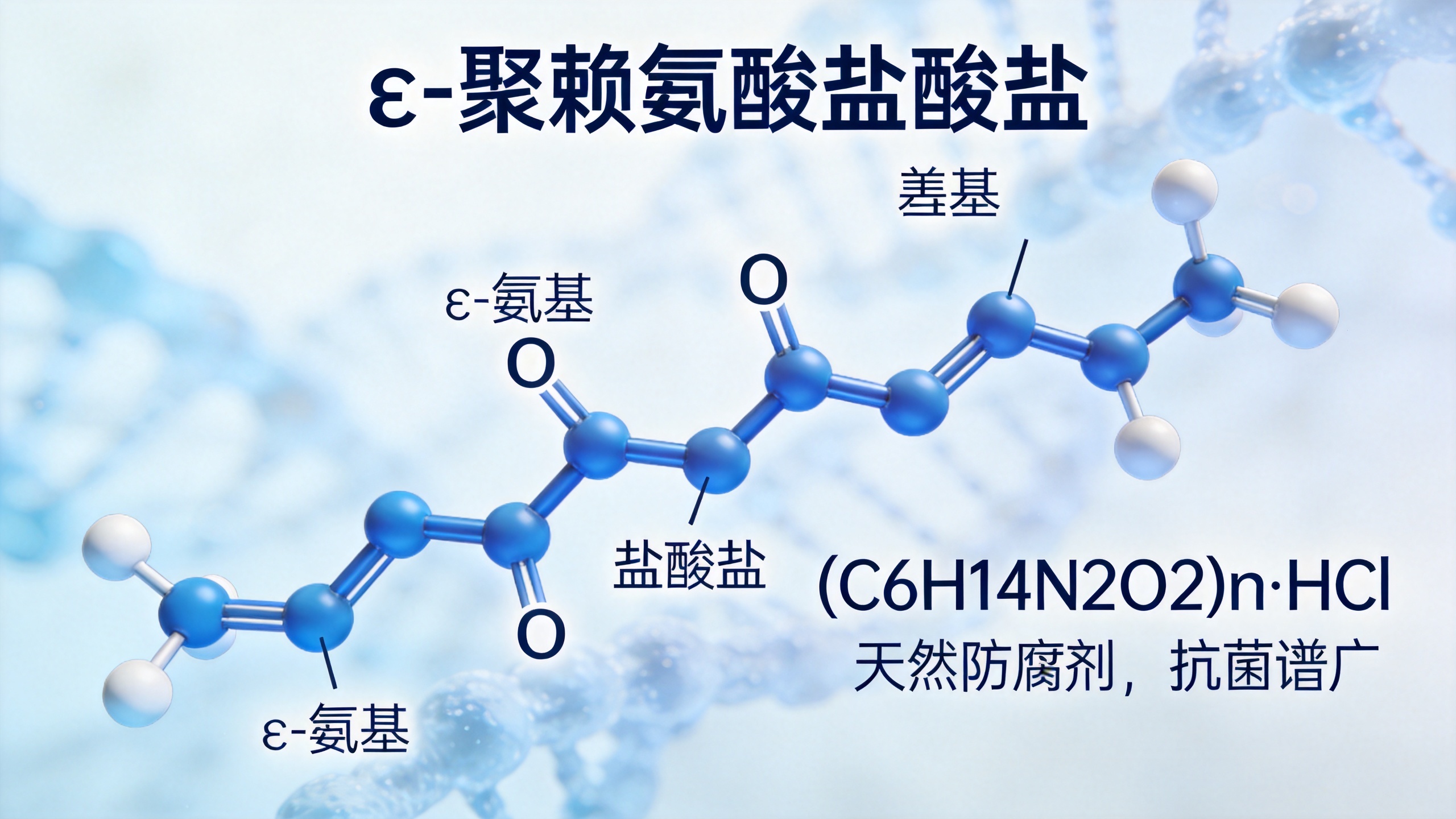
ε-polylysine hydrochloride is a kind of natural cationic polypeptide preservative produced by microbial fermentation process. Its chemical nature is the same type polymer formed by the amide bond of L-lysine residue formed by ε-amino group and α-carboxyl group. Unlike α-polylysine, its unique ε-bond linkage structure gives it excellent biocompatibility and degradability, making it an ideal alternative to traditional chemical preservatives.
Terminology dismantling
-"ε-": indicates that lysine molecules form amide bonds with the α-carboxyl group of adjacent lysine through ε-amino group (amino group at the end of side chain), which is a key feature different from common protein peptide bonds (α-amino group connection)
-"Polylysine": a polymer compound formed by the polymerization of multiple L-lysine monomers, the degree of polymerization is usually 25-35 monomers
-"Hydrochloride": refers to the stable salt form formed by the combination of polylysine molecules and hydrochloric acid, which is a common form of commercial products and is conducive to improving stability and water solubility.
essential attribute
ε-polylysine hydrochloride is essentially a cationic polypeptide with a broad spectrum of antibacterial activity, with a molecular weight range of 3600-4300 daltons (corresponding to 25-35 lysine residues). Each lysine residue in its molecular structure has a positively charged amino group, which enables it to bind to the negatively charged microbial cell membrane through electrostatic interaction, thus exerting antibacterial effect. The isoelectric point of the substance is about 9.04, and it maintains a positive charge in the pH range of 2-9, which is the molecular basis for its antibacterial activity under a wide range of pH conditions.
synonymous/near-synonymous expressions
-ε-Polylysine (often referred to as hydrochloride)
-Poly-lysine hydrochloride
-ε-PL · HCl (English abbreviation)
-ε-Poly-L-lysine hydrochloride
-Poly-L-lysine hydrochloride
Applicable boundary
As a food additive, the use of ε-polylysine hydrochloride must strictly follow the provisions of GB 2760-2024 "National Food Safety Standards for the Use of Food Additives: it is allowed to be used in fruits, vegetables (including root tubers), beans, edible fungi, algae, nuts and seeds (maximum usage 0.30 g/kg), rice and products (0.25 g/kg), wheat flour and its products (0.30 g/kg), coarse cereals products (0.40 g/kg), meat and meat products (0.30 g/kg), condiments (0.50 g/kg), beverages (0.20G/kg), etc. It is important to note that since February 8, 2025, the use of ε-polylysine hydrochloride has been explicitly prohibited in canned foods. In addition, the amount of the substance used in food needs to be precisely controlled to avoid affecting the original flavor of the food.
historical evolution
The discovery of ε-polylysine can be traced back to 1977, when Japanese scholars Shoji Shima and Heiichi Sakai isolated the substance from the fermentation broth of Streptomyces albicans for the first time. In the late 1980 s, the Ministry of Health, Labor and Welfare of Japan approved its use as a food preservative, becoming the world's first commercially applied polylysine product. On January 16, 2004, the U.S. Food and Drug Administration (FDA) officially approved epsilon-polylysine as a generally recognized as safe (GRAS) substance (GRN No. 000135), further promoting its global application. On April 3, 2014, China issued Announcement No. 5 of 2014 by the former National Health and Family Planning Commission, officially approving ε-polylysine hydrochloride as a new variety of food additives. After entering the 2020 s, with the development of synthetic biology technology, the fermentation titer of ε-polylysine increased from 10-20g/L in the early stage to more than 45g/L, and the production cost decreased significantly, driving its market penetration rate to increase rapidly.
Interpretation from different perspectives
From the perspective of food science, ε-polylysine hydrochloride is an ideal natural preservative, which has the dual advantages of high efficiency and safety, can effectively extend the shelf life of food, reduce food waste, and avoid the health risks that chemical preservatives may bring. From the perspective of microbiology, it is an antibacterial peptide with defense function in the secondary metabolites of microorganisms. Its mechanism of action is different from that of traditional antibiotics, and it is not easy to produce drug resistance, which provides a new way of thinking for the fight against drug-resistant bacteria. From the perspective of nutrition, it can be degraded into the essential amino acid lysine in the human body, which is not only non-toxic and side effects, but also has certain nutritional value, which is a unique advantage that other preservatives cannot match. From the perspective of industrial biotechnology, it is a typical product of biological manufacturing industry and represents the development direction of green chemical industry. Its production process is environmentally friendly and conforms to the concept of sustainable development.
Comparison of related concepts
Compared with traditional chemical preservatives (such as sodium benzoate and potassium sorbate), ε-polylysine hydrochloride has the advantages of natural source, higher safety, wider antibacterial spectrum, wider pH application range and better thermal stability, but the current cost is still relatively high. Compared with nisin, both are biogenic preservatives, but ε-polylysine has a wider antibacterial spectrum and a good inhibitory effect on gram-negative bacteria, while Nisin mainly targets gram-positive bacteria. ε-polylysine has a wider pH range and can still maintain its activity under neutral and alkaline conditions, while Nisin's activity decreases significantly at pH>6. Compared with natamycin, ε-polylysine has inhibitory effect on both bacteria and fungi, while natamycin mainly targets mold and yeast, with a relatively narrow inhibitory spectrum.
Industry Overview
industrial chain structure
The ε-polylysine hydrochloride industry chain can be divided into three core links: upstream raw material supply, midstream manufacturing and downstream application. Upstream mainly includes carbon sources (glucose, starch sugar, etc.), nitrogen sources (corn syrup, yeast extract, etc.), inorganic salts and hydrochloric acid and other basic chemical raw materials, of which lysine raw material price fluctuations have a greater impact on production costs. The midstream is the fermentation production link, covering the key processes such as strain selection, fermentation control, separation and purification, finished product processing, and the technical barriers are mainly reflected in the construction of high-yield strains and efficient extraction process. Downstream applications take the food industry as the core, extending to the fields of daily chemicals, medicine, feed, etc., of which food preservation accounts for about 60%, which is the most important application scenario. The profit distribution of the industrial chain shows the characteristics of "smiling curve": the profit of upstream raw material supply is about 15%-20%, the profit of midstream production and manufacturing can reach up to 30%-40%, and the profit of downstream application end is about 20%-25%.
Market size
In terms of global market, according to the data of QYResearch and other institutions, the global market size of ε-polylysine hydrochloride in 2024 is about US $0.524 billion, which is expected to reach US $0.813 billion by 2031, and the annual compound growth rate (CAGR) during 2025-2031 is about 6.5. In terms of sales volume, the global total sales volume in 2024 is about 28000 tons, and it is expected to exceed 43000 tons in 2031. In terms of regional distribution, the Asia-Pacific region dominates the global market, accounting for about 55%, of which China is the largest producer and consumer; North America accounts for about 22%, Europe about 15%, and other regions together about 8%.
In the Chinese market, the market size reached 0.58 billion billion yuan in 2025, up 12.6 percent year-on-year, continuing the steady expansion trend since 2022. Historically, the market size is $0.457 billion in 2023 and $0.515 billion in 2024, with a compound annual growth rate of 11.3-13.7 percent in the last three years. In terms of production capacity, China's total production capacity will reach about 5200 tons/year in 2025 and is expected to exceed 5800 tons/year in 2026. In terms of production, China's production of epsilon-polylysine will reach 3800 tons in 2023, accounting for 41.7 percent of the world's total production, and is expected to expand to 12000 tons in 2030. In terms of exports, exports to Southeast Asia and the Middle East reached 0.138 billion billion yuan in 2025, up 29.4 percent year-on-year, and export contribution is expected to continue to increase as Chinese products pass FDA GRAS certification and EU EFSA filing.
Key Participants
The global epsilon-polylysine hydrochloride market presents an oligopolistic competition pattern, with CR3 (market concentration of the top three enterprises) at about 65%. The main international participants include: JNC Co., Ltd. of Japan (formerly Chisso, as the first enterprise to realize industrialization, master the core patent technology), Danish Biozymes company, American Handary company, etc. Chinese local enterprises have significant advantages in cost and production capacity. The main production enterprises include: Zhejiang Xinyinxiang Biological Engineering Co., Ltd. (one of the largest domestic enterprises with the largest production capacity, and the product quality has reached the international advanced level), Jiangsu Yiming Biological Co., Ltd., Zhengzhou Bennaver Biological Engineering Co., Ltd., Luoyang Qihong Biotechnology Co., Ltd., Hubei Haijia Biotechnology Co., Ltd., Shaanxi Chenming Biotechnology Co., Ltd. In addition, Shandong Keyuan pharmaceutical, Jinyang biological and other enterprises are also actively layout of the field. From the perspective of competition, local companies dominate the low-end market, and international companies have advantages in high-end customized products and compounding technology, but this gap is rapidly narrowing.
development stage
The ε-polylysine hydrochloride industry is currently in the stage of transition from growth to maturity. Its main characteristics are as follows: continuous optimization of technology and process, steady increase of fermentation titer and extraction yield, and decrease of unit production cost by about 18.6 in the past three years; The application field of products continues to expand, extending from traditional food preservation to high-end fields such as daily chemicals and medicine. The market concentration is gradually increasing, and the head enterprises consolidate their dominant position through capacity expansion and technological upgrading; the policy standard system is becoming more and more perfect, and the implementation of GB 1886.371-2023 and other countries promotes the standardized development of the industry. Compared with developed countries, China is already competitive in fermentation capacity and cost control, but there is still room for improvement in the development of high-end pharmaceutical grade products, compound technology innovation and brand building.
regional pattern
China's ε-polylysine hydrochloride industry presents obvious regional agglomeration characteristics. The Yangtze River Delta region is the core industrial agglomeration area, accounting for about 55% of the national production capacity. Zhejiang and Jiangsu provinces have gathered a number of leading enterprises in the industry, relying on the advantages of a sound biopharmaceutical industry chain and technical personnel. in a leading position in product research and development and quality control. The Bohai Rim region (Shandong, Hebei, etc.) relies on rich agricultural and sideline product resources and fermentation industrial base, and its production capacity accounts for about 25%. The central and western regions (Hubei, Shaanxi, etc.) have developed rapidly in recent years. Relying on industrial transfer policies and cost advantages, the proportion of production capacity has increased to about 20%. In terms of the consumer market, the Pearl River Delta region had the fastest growth rate of 22.4 per cent, mainly benefiting from a developed food industry and strong consumer health awareness, followed by the Yangtze River Delta and Beijing-Tianjin-Hebei regions with growth rates of 20.1 per cent and 18.7 per cent respectively.
Industry pain points
At present, the main challenges facing the industry include: first, the production cost is still relatively high. Although it has been significantly reduced through technological progress in recent years, the price is still 3-5 times higher than that of traditional chemical preservatives such as sodium benzoate and potassium sorbate, which limits the wide application of price-sensitive products; second, the compounding technology is not mature, and a single preservative is difficult to meet the needs of complex food systems, however, the ability of domestic enterprises in the research and development of compound formula and application of technical services needs to be improved. Third, high-end products have obvious shortcomings. The average chromatographic separation yield of pharmaceutical grade ε-polylysine is only 68.4, 9.2 percentage points lower than that of leading Japanese enterprises. There is still a gap in product purity and quality stability. Fourth, market awareness needs to be improved, and some food enterprises and consumers do not know enough about this new preservative, this has affected the further improvement of market penetration; fifth, the trade barriers brought about by differences in international regulations, and the different approval standards and regulations on the use of food additives in different countries have increased the compliance costs of enterprises' exports.
Driving Factors
The core driving force of industry growth comes from the synergy of many aspects. At the policy level, the "14th Five-Year Plan for the Development of Bioeconomy" lists microbial manufacturing as a key project, and the continuous improvement of the standards for the use of food additives provides an institutional guarantee for the development of the industry. At the market level, consumers' attention to food safety and health continues to increase, with 76% of consumers willing to pay a 10%-15% premium for foods containing natural preservatives, promoting food enterprises to accelerate the replacement of chemical preservatives. The explosive growth of the prefabricated vegetable industry (the scale is expected to exceed 620 billion yuan in 2026, up 21.3 year on year) has created a huge demand for corrosion protection. At the technical level, the application of synthetic biology technology has continuously improved the fermentation titer, reduced the production cost, and enhanced the market competitiveness of the product. At the social level, the global trend of reducing food waste and developing a green and low-carbon economy also provides a good social environment for the application of natural preservatives.
Technical Standards
International Standards
At present, there is no special product standard for ε-polylysine hydrochloride in the world, but the relevant international standards and specifications provide an important reference for its quality control. The United Nations Food and Agriculture Organization/World Health Organization Joint Expert Committee on Food Additives (JECFA) conducted a safety assessment of ε-polylysine and formulated relevant quality specifications, including purity index (≥ 95% on a dry basis), heavy metal limit (lead ≤ 2 mg/kg, arsenic ≤ 3 mg/kg), microbial index, etc. The relevant general standards of the Codex Alimentarius Commission (CAC) also apply to international trade in this product. In addition to granting GRAS certification, the US FDA also specified the conditions of use and quality requirements for ε-polylysine as a food additive in 21 CFR PART 172. The International Organization for Standardization (ISO) is considering the development of relevant product standards to promote the standardization of global trade.
National Standards
China has established a complete national standard system for ε-polylysine hydrochloride. The core standards include: GB 1886.371-2023 "National Food Safety Standard Food Additive ε-Polylysine Hydrochloride", which was released on September 6, 2023 and implemented on March 6, 2024, replacing the previous temporary specification. The standard specifies the technical requirements, inspection methods, packaging, labeling, transportation and storage of ε-polylysine hydrochloride. Sensory requirements are white to cream yellow powder; Physical and chemical indexes include: ε-polylysine hydrochloride content (calculated as dry product) ≥ 95.0, drying reduction ≤ 8.0, pH(10g/L aqueous solution) 2.5-5.5, lead ≤ 2.0 mg/kg, residue on ignition ≤ 2.0, total arsenic (calculated as O₂) ≤ 3.0 mg/kg. Another important standard is GB 2760-2024 "National Food Safety Standards for the Use of Food Additives", which specifies in detail the maximum use of ε-polylysine hydrochloride in various foods and is the main basis for compliance. In addition, GB 5009 series standards provide a unified specification for the detection methods of various indicators.
Industry Standard
In addition to national standards, relevant industry organizations and associations are also actively formulating industry standards and group standards to fill the gaps in national standards and promote technological progress. The China Food Additives and Ingredients Association is taking the lead in formulating the group standard "ε-polylysine hydrochloride compound preservative for food", which aims to standardize the quality requirements and production process of compound products. The China Bio-fermentation Industry Association also incorporated ε-polylysine into the industry development plan, and formulated industry access standards for product energy consumption and environmental protection. Some key enterprises have also formulated enterprise standards higher than the national standards. For example, the enterprise standard of an enterprise in Zhejiang has raised the requirement of ε-polylysine content to ≥ 98%, and the limit requirements of heavy metals are more stringent, so as to enhance the competitiveness of products and meet the needs of high-end customers.
certification system
The main certifications of ε-polylysine hydrochloride include: FDA's GRAS (Generally Recognized Safety) certification, which is a necessary condition for entering the US market and was obtained in 2004 (GRN No. 000135); Kosher (Kosher) certification and halal (Halal) certification are essential for entering the market in specific religious belief areas; ISO 22000 food safety management system certification is a basic requirement for food production enterprises; BRC (British Retail Consortium) global food standards certification, is a passport to enter the European retail market; FSSC 22000 certification, is the Global Food Safety Initiative (GFSI) recognized certification system. For export enterprises, it is also necessary to obtain the food additive production license or record of the target country, such as the EFSA assessment of the European Union and the KFDA registration of South Korea.
Standards Evolution
The standard system of ε-polylysine hydrochloride in China has experienced a process of gradual improvement from scratch. When it was approved as a new variety of food additives in 2014, the quality specifications stipulated in the announcement of the former National Health and Family Planning Commission were implemented, which was a temporary specification. In 2022, GB 1886.362-2022 "Food Additive ε-Polylysine" was released, but the standard is mainly for non-hydrochloride forms. In 2023, the GB 1886.371-2023 standard specifically for the hydrochloride form was released, marking the formal establishment of China's ε-polylysine hydrochloride standard system. GB 2760 standard has also continuously improved the use regulations of ε-polylysine in previous revisions. When it was first included in 2014, only 7 types of food were allowed to be used. By 2024, the standard had been extended to dozens of food subcategories, and the use scope had been greatly expanded. The development direction of future standards includes: increasing the classification standards of different levels of products (such as pharmaceutical grade, cosmetic grade), improving the standards of testing methods, and formulating standards for compound products.
Standard comparison
National standards are basically consistent in the main indicators, but there are some differences. In terms of content index, China's national standard requires ≥ 95%, US FDA requires ≥ 94%, and Japanese standard requires ≥ 96%, with little difference between the three. In terms of heavy metal indicators, China's lead limit is ≤ 2 mg/kg, the United States and Japan are ≤ 3 mg/kg, and China's standards are more stringent. In terms of drying reduction, China requires ≤ 8.0%, the United States requires ≤ 10%, and Japan requires ≤ 7.0%. In terms of pH range, China is 2.5-5.5, the United States is 3.0-6.0, and Japan is 2.0-5.0. On the whole, China's national standards are relatively strict in terms of safety indicators, reflecting the high importance of food safety. In actual trade, enterprises need to adjust the production process and quality control parameters according to the standard requirements of the target market.
Standard Implementation
The implementation of national standards has had a profound impact on the industry. On the one hand, the unified product quality standards standardize the market order, eliminate a number of small enterprises with backward technology and substandard quality, and promote the improvement of industry concentration; on the other hand, clear quality requirements promote enterprises to increase investment in technological transformation and improve product quality and stability. In the implementation process, the regulatory authorities ensure that the standards are implemented in place through production license review, supervision and sampling. In the supervision and sampling inspection of food additives organized by the State Administration of Market Supervision and Administration every year, the qualified rate of ε-polylysine hydrochloride remained above 98%. At the same time, the implementation of standards has also promoted technological exchanges and progress in the industry. Enterprises have continuously improved their own technical level and product competitiveness through benchmarking national standards and international advanced standards.
Future standards
In the future, the standard system of ε-polylysine hydrochloride will be further improved. It is expected that progress will be made in the following aspects: first, to formulate grading standards for different application fields, and to formulate corresponding quality indicators according to the different requirements of food grade, cosmetic grade and pharmaceutical grade; second, to improve the detection method standards, especially the rapid detection method for ε-polylysine content, to meet the needs of online monitoring of production process and rapid market screening; third, to formulate compound product standards, standardize the quality and safety of ε-polylysine and other preservatives; fourth, participate in the formulation of international standards to enhance China's international voice in this field; fifth, formulate green production standards to guide the sustainable development of the industry from the aspects of raw materials, energy consumption and environmental protection.
Application Areas